DOL Overtime Exemption Salary Threshold: What You Need to Know
Advertisements
Managing workplace compensation and wage structures requires navigating shifting federal regulations and strict FLSA compliance rules. Understanding the DOL Overtime Exemption Salary Threshold enables U.S. business leaders and HR teams to accurately classify staff members and avoid costly payroll liabilities.
Federal labor mandates specify minimum weekly earnings limits alongside administrative, executive, and professional duties tests for exempt worker status. Restructuring salaried positions ensures businesses maintain legal compliance while optimizing overtime eligibility and overall workforce cost efficiency.
Proactively monitoring Department of Labor adjustments prevents sudden operational friction and reclassification challenges across American businesses. Here is what HR professionals and employers need to track regarding FLSA requirements and salary level benchmarks.
Department of Labor Raises Overtime Exemption Salary Threshold
The U.S. Department of Labor (DOL) has finalized a rule significantly increasing the minimum salary threshold for executive, administrative, and professional (EAP) employees to be exempt from overtime pay. This long-anticipated change is set to take effect in phases, with the 2026 threshold reaching $58,656 annually.
This move represents a substantial increase from the current threshold, impacting a broad spectrum of industries and job roles. Employers are now tasked with understanding the full scope of these changes and implementing necessary adjustments to their payroll and classification systems.
The DOL's announcement underscores a commitment to updating labor standards that have not kept pace with economic realities. This updated overtime exemption salary threshold is designed to extend overtime protections to a larger segment of the workforce.
Phased Implementation of the New Rule
The new rule will be implemented in a phased approach, providing businesses with a transition period to adapt. Initially, the threshold will increase to $43,888 on July 1, 2024, followed by the more significant jump to $58,656 on January 1, 2025, and then to $58,656 on January 1, 2026.
This staged implementation allows companies to gradually adjust their compensation structures and employee classifications. It also provides an opportunity for employers to educate their workforce about the upcoming changes and address any potential concerns regarding their exempt status.
Employers should not delay in reviewing their current employee classifications and salary levels. Proactive planning is essential to ensure a smooth transition and full compliance with the updated overtime exemption salary threshold when each phase takes effect.
Initial increase to $43,888 effective July 1, 2024.
Further increase to $58,656 effective January 1, 2025.
Final threshold of $58,656 effective January 1, 2026.
Regular updates every three years based on wage data.
Who is Affected by the New Overtime Rules?
The updated overtime exemption salary threshold primarily affects employees classified under the Fair Labor Standards Act's (FLSA) EAP exemptions. These are often referred to as "white-collar" exemptions, covering executive, administrative, and professional roles.
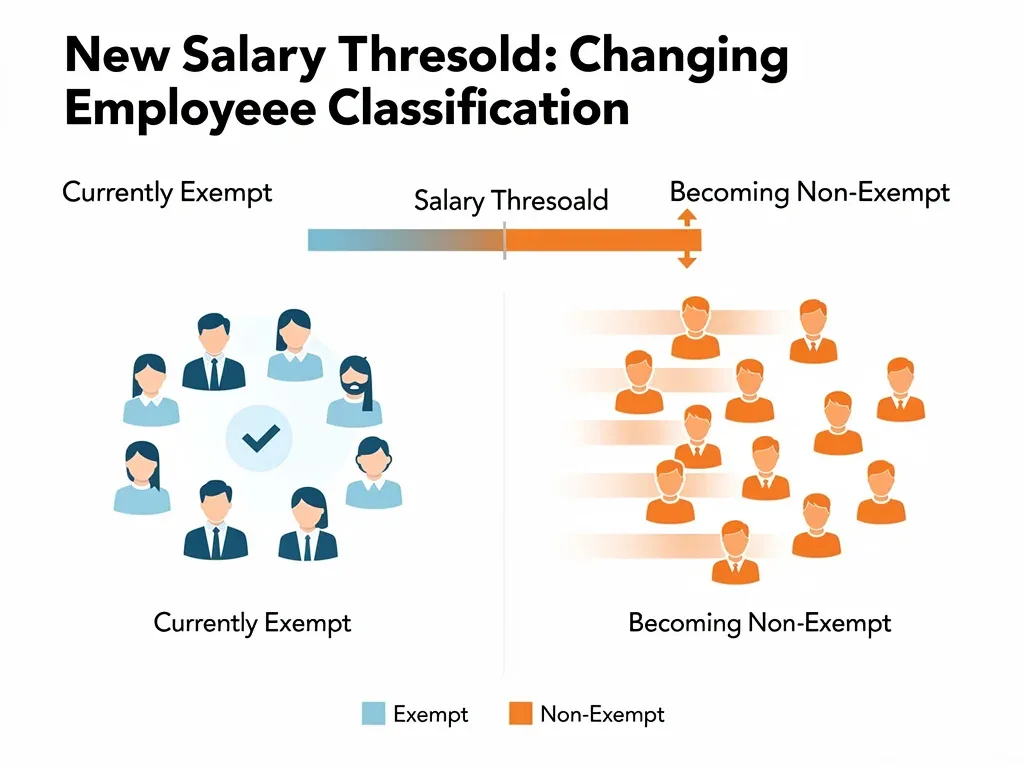
Employees whose salaries fall below the new threshold, even if they perform duties typically considered exempt, will become eligible for overtime pay. This means they must be paid 1.5 times their regular rate for all hours worked over 40 in a workweek.
Businesses must carefully analyze their workforce to identify employees who will be reclassified due to the Department of Labor Rolls Out Updated Overtime Exemption Salary Threshold of $58,656 for 2026. Misclassification can lead to significant penalties, including back pay and legal fees.
Impact on Small and Large Businesses
Both small and large businesses will feel the effects of this rule change, though the magnitude may vary. Larger corporations with established HR departments may have more resources to adapt, but small businesses might face greater challenges in re-evaluating their payroll and compensation strategies.
Small businesses, in particular, may need to make difficult decisions regarding salary increases or reclassifying employees to non-exempt status. This could lead to increased labor costs or operational adjustments to manage overtime hours effectively.
Regardless of size, every employer must understand how the Department of Labor Rolls Out Updated Overtime Exemption Salary Threshold of $58,656 for 2026 impacts their specific operations. Seeking legal or HR counsel can help navigate these complexities.
Increased labor costs for employers.
Potential for reclassification of many currently exempt employees.
Need for updated timekeeping and payroll systems.
Risk of litigation for non-compliance.
Understanding the Fair Labor Standards Act (FLSA) Exemptions
The FLSA establishes minimum wage, overtime pay, recordkeeping, and youth employment standards affecting employees in the private sector and in Federal, State, and local governments. Central to this act are the exemptions that allow certain employees to be paid on a salary basis without overtime.
To qualify for an EAP exemption, an employee must meet three tests: a salary level test, a salary basis test, and a duties test. The new rule primarily addresses the salary level test, significantly raising the bar for exemption.
The Department of Labor Rolls Out Updated Overtime Exemption Salary Threshold of $58,656 for 2026 directly modifies this critical component, making it more challenging for employers to classify employees as exempt without paying a competitive salary.
The Salary Level and Salary Basis Tests
The salary level test dictates the minimum amount an employee must be paid weekly to be considered for exemption. With the new rule, this minimum increases substantially, meaning many employees currently considered exempt will no longer meet this criterion.
The salary basis test requires that an employee receive a predetermined and fixed salary that is not subject to reduction because of variations in the quality or quantity of work performed. This test remains a critical component of the exemption criteria.
Employers must ensure that both the salary level and salary basis tests are met, in addition to the duties test, for an employee to be properly classified as exempt. The Department of Labor Rolls Out Updated Overtime Exemption Salary Threshold makes the salary level a primary focus for compliance.

Strategies for Employers to Ensure Compliance
Given the impending changes, employers must develop robust strategies to ensure compliance with the new overtime rules. This involves a thorough review of current employment practices and potential adjustments to compensation and operational models.
One primary strategy is to identify all employees currently classified as exempt whose salaries fall below the new threshold. For these employees, employers have several options: raise their salaries to meet the new threshold, reclassify them as non-exempt and pay overtime, or adjust workloads to limit hours.
Proactive communication with employees about these changes is also vital to maintain transparency and morale. Employers should explain the reasons behind any reclassifications or adjustments in compensation due to the Department of Labor Rolls Out Updated Overtime Exemption Salary Threshold of $58,656 for 2026.
Reviewing Employee Classifications and Compensation
Employers should conduct a comprehensive audit of all exempt positions to determine which employees will be impacted. This audit should include reviewing job descriptions, actual duties performed, and current salary levels against the new federal requirements.
For employees whose salaries are close to the new threshold, increasing their pay to maintain exempt status might be the most straightforward solution. However, for those significantly below, reclassification to non-exempt status may be more economically viable, necessitating new timekeeping procedures.
Implementing accurate time tracking for newly non-exempt employees is crucial. Companies will need reliable systems to record all hours worked, including any overtime, to ensure proper compensation under the Department of Labor Rolls Out Updated Overtime Exemption Salary Threshold.
Conduct a detailed audit of all exempt positions.
Identify employees whose salaries fall below the new thresholds.
Consider raising salaries to meet the new exemption levels.
Prepare for reclassification of employees to non-exempt status.
Economic Implications of the Updated Threshold
The increase in the overtime exemption salary threshold carries significant economic implications for businesses and the broader economy. While designed to benefit workers, it also presents challenges for employers, particularly those operating on tight margins.
Increased labor costs are a primary concern for many businesses, potentially leading to adjustments in pricing, staffing levels, or automation investments. These decisions will have ripple effects across various sectors of the economy.
The Department of Labor Rolls Out Updated Overtime Exemption Salary Threshold could also stimulate wage growth for some mid-level positions. This might lead to increased consumer spending, providing a boost to local economies.
Potential for Wage Growth and Business Adjustments
For employees who receive salary increases to meet the new threshold, there will be a direct improvement in their take-home pay. For those reclassified as non-exempt, the potential for overtime earnings offers a similar financial benefit.
Businesses, however, will need to balance these increased labor costs with their overall financial health. Some may choose to absorb the costs, while others might explore strategies such as hiring more part-time employees, optimizing schedules, or investing in technology to enhance productivity.
The long-term economic impact of the Department of Labor Rolls Out Updated Overtime Exemption Salary Threshold will depend on how widely businesses adapt and the overall health of the U.S. economy. Monitoring these trends will be crucial for policymakers and businesses alike.
Historical Context and Future Outlook of Overtime Rules
The FLSA's overtime provisions have been subject to numerous adjustments and legal challenges since their inception. The current update is part of a recurring effort by the DOL to ensure these regulations remain relevant in a changing economic landscape.
Previous attempts to significantly raise the overtime exemption salary threshold have faced legal hurdles and varied implementation. This latest rule aims to provide greater stability and predictability for both employers and employees.
The Department of Labor Rolls Out Updated Overtime Exemption Salary Threshold sets a precedent for future adjustments, as the rule includes provisions for automatic updates every three years, based on current wage data.
Regular Updates and Long-Term Planning
The provision for regular updates means that employers cannot view this as a one-time change. Instead, they must incorporate ongoing monitoring of salary thresholds into their long-term HR and compensation planning strategies.
This predictability can be beneficial, allowing businesses to anticipate future increases and plan accordingly, rather than reacting to sudden, large adjustments. It fosters a more stable regulatory environment for wage and hour compliance.
Understanding the historical context of overtime rules helps in appreciating the significance of the Department of Labor Rolls Out Updated Overtime Exemption Salary Threshold and its implications for the future of work in the United States.
FLSA overtime rules have a history of adjustments and challenges.
The current rule aims for greater stability and predictability.
Automatic updates every three years will adjust the threshold based on wage data.
Employers must integrate ongoing monitoring into long-term planning.
Resources and Support for Employers and Employees
Navigating the complexities of the new overtime rules can be challenging. Fortunately, numerous resources are available to help both employers and employees understand their rights and obligations.
The Department of Labor's Wage and Hour Division provides extensive guidance, fact sheets, and FAQs on its website, offering official interpretations and compliance assistance. Industry associations and legal experts also offer valuable insights and support.
Employers should consider consulting with legal counsel or HR professionals to ensure their specific practices align with the updated overtime exemption salary threshold. Employees who believe their rights are being violated can also seek assistance from the DOL.
Leveraging Expert Advice and Official Guidance
For businesses, engaging with employment law attorneys can provide tailored advice on employee classification, compensation strategies, and compliance audits. This proactive approach can help mitigate risks associated with misclassification.
Employees should familiarize themselves with the new rules to understand if their eligibility for overtime pay has changed. Official DOL resources are the most reliable source of information for understanding their rights.
Staying informed and seeking expert guidance will be crucial for all parties as the Department of Labor Rolls Out Updated Overtime Exemption Salary Threshold takes full effect. These resources are designed to facilitate a smooth transition for everyone involved.
The Broader Impact on the American Workforce
The updated overtime exemption salary threshold is expected to have a broad and positive impact on the American workforce. Millions of workers who were previously exempt may now become eligible for overtime pay, leading to increased earnings and improved work-life balance.
This change reinforces the principle of fair compensation for hours worked, particularly for those in mid-level professional roles. It also encourages employers to manage employee workloads more efficiently to avoid excessive overtime costs.
Ultimately, the Department of Labor Rolls Out Updated Overtime Exemption Salary Threshold is a significant step towards strengthening worker protections and ensuring that the FLSA's original intent of promoting fair labor standards is upheld in today's economy.
Promoting Fair Compensation and Work-Life Balance
For many employees, becoming eligible for overtime pay means greater financial security. This can translate into more disposable income, the ability to save more, or simply a fairer reward for their efforts.
Employers, in turn, may be incentivized to re-evaluate staffing levels and operational efficiencies to reduce reliance on extensive overtime. This could lead to more balanced workloads for employees and potentially new job creation.
The long-term goal of the Department of Labor Rolls Out Updated Overtime Exemption Salary Threshold is to create a more equitable and sustainable labor market. Its success will be measured by its ability to deliver on these promises for both workers and businesses.
Key Point | Brief Description |
|---|---|
New Threshold | Overtime exemption salary threshold updated to $58,656 for 2026. |
Phased Implementation | Incremental increases starting July 1, 2024, reaching final amount by 2026. |
Impact on Employees | More workers eligible for overtime pay, potentially increasing earnings. |
Employer Compliance | Businesses must review classifications and adjust payroll systems. |
Frequently Asked Questions About the New Overtime Rules
What is the new overtime exemption salary threshold for 2026?▼
The Department of Labor has set the updated overtime exemption salary threshold at $58,656 annually for 2026. This is part of a phased increase, with an initial rise to $43,888 on July 1, 2024, and then to $58,656 on January 1, 2025, before reaching the final 2026 figure.
When do these new overtime rules take effect?▼
The new rules will be implemented in stages. The first increase takes effect on July 1, 2024. A subsequent increase to $58,656 will occur on January 1, 2025, with the full $58,656 threshold becoming effective on January 1, 2026. Employers should plan for these dates.
Which employees are affected by this change?▼
Employees classified under the executive, administrative, and professional (EAP) exemptions whose salaries fall below the new thresholds will be affected. If their salary is less than $58,656 annually by 2026, they will become eligible for overtime pay for hours worked over 40 in a week.
What should employers do to prepare for the updated overtime exemption salary threshold?▼
Employers should conduct an audit of their exempt employees, identify those whose salaries are below the new threshold, and decide whether to raise their salaries or reclassify them as non-exempt. Implementing accurate timekeeping systems for reclassified employees is also crucial.
Will the overtime exemption salary threshold change again in the future?▼
Yes, the rule includes a provision for automatic updates to the salary threshold every three years. These future adjustments will be based on current wage data, ensuring the threshold remains relevant and keeps pace with economic changes and inflation.
Impact and Implications
The Department of Labor Rolls Out Updated Overtime Exemption Salary Threshold represents a significant regulatory shift with far-reaching implications for the American labor market. This change mandates a careful re-evaluation of compensation structures across industries, ensuring fair pay for millions of workers.
Businesses must prioritize compliance, understanding that proactive adjustments can prevent costly legal issues and maintain employee morale. The phased implementation offers a critical window for strategic planning and adaptation, rather than last-minute reactions.
As the new threshold takes full effect, its impact on wage growth, employment practices, and overall economic dynamics will be closely monitored. This move underscores a continued commitment to strengthening worker protections and modernizing labor standards in the United States.
Ultimately, the Department of Labor Rolls Out Updated Overtime Exemption Salary Threshold is a significant step towards strengthening worker protections and ensuring that the FLSA's original intent of promoting fair labor standards is upheld in today's economy.
Promoting Fair Compensation and Work-Life Balance
For many employees, becoming eligible for overtime pay means greater financial security. This can translate into more disposable income, the ability to save more, or simply a fairer reward for their efforts.
Employers, in turn, may be incentivized to re-evaluate staffing levels and operational efficiencies to reduce reliance on extensive overtime. This could lead to more balanced workloads for employees and potentially new job creation.
The long-term goal of the Department of Labor Rolls Out Updated Overtime Exemption Salary Threshold is to create a more equitable and sustainable labor market. Its success will be measured by its ability to deliver on these promises for both workers and businesses.
